Toronto and Tel Aviv are usually seven hours apart, which gives you a shared window every working day (Toronto morning, Israeli afternoon) and a long stretch where one side works while the other sleeps. Used well, that means decisions made together in the overlap, work that moves forward overnight, and a local contact in your time zone. It only works with disciplined written handoffs, one shared backlog and clear ownership.
DevDino has two offices: Toronto and Tel Aviv. Clients often ask about it on a first call, usually as some version of “Is that a strength or a complication?”
Honest answer: it is a strength when the team is set up for it, and a complication when it is not. This post explains how a Toronto and Tel Aviv team works in practice, what you gain, and what to ask any distributed team before you hire them.
The clock, plainly
Toronto runs on Eastern Time and Tel Aviv on Israel Time. Most of the year they are seven hours apart. Because Canada and Israel change their clocks on different dates, there are a few weeks in spring and autumn when the gap shifts. Put every recurring meeting in the calendar in both time zones and the problem disappears.
What that looks like on a normal working day:
| Toronto | Tel Aviv | What usually happens |
|---|---|---|
| Early morning | Early afternoon | Israeli engineers finishing their main build block |
| Morning | Afternoon to evening | The overlap: stand-ups, demos, decisions, client calls |
| Afternoon | Night | Toronto side continues, reviews, tests, prepares questions |
| Evening | Early morning | Israeli side starts with answers and reviewed work waiting |
Two more details matter. The Israeli work week runs Sunday to Thursday, with Friday short or off; the Canadian week runs Monday to Friday. So Sunday is an Israeli working day and Friday is mostly a Canadian one. Plan releases and on-call accordingly.
What the overlap is for
The shared window is valuable, so protect it. Use it for the things that genuinely need people in the same conversation:
- Decisions that block work: scope questions, design choices, priority calls.
- Demos of what was built, with the client in the room.
- Unblocking: the questions that would otherwise wait a day.
Do not spend it on status updates that could be written. A short written update read before the meeting saves the meeting for decisions.
Handoffs that actually work
Work that moves between time zones lives or dies on the handoff. A good handoff is short, written, and answers four questions:
- What was done, with links to the pull request, ticket or build.
- What is blocked, and on whom.
- What the next person should pick up, in priority order.
- What is risky, so nobody ships something half-understood.
Add a few rules and the system holds:
- One backlog. Not a Toronto list and a Tel Aviv list.
- Clear ownership. Every ticket has one owner at a time. Handing it over is an explicit act.
- Acceptance criteria before code. If the next person cannot tell when it is done, it is not ready to hand over.
- Recorded demos. A short screen recording often replaces a meeting across time zones.
Follow-the-sun, without the buzzword
“Follow-the-sun” gets oversold. You do not get double the output by having two time zones. What you do get, with the handoffs above, is less waiting:
- A question raised in the Israeli afternoon can be answered by the Toronto morning team before Israel starts the next day.
- Code written in Tel Aviv can be reviewed and tested in Toronto the same calendar day.
- A bug reported by a North American client late in their day can be looked at before they are back at their desks.
- Releases can go out at quiet hours for your users, with someone awake on the other side to watch.
The gain is calendar time, not magic. For a client waiting on a feature, that is often what matters most.
Israeli engineering culture, in practice
Israel’s tech industry has a reputation, and a few traits show up often in how Israeli engineers work. Generalisations have limits, but these are worth knowing:
- Directness. If a plan has a problem, you will hear about it early, plainly. It can feel blunt at first. It is also how you avoid a month of building the wrong thing.
- Pragmatism. A preference for the solution that works now and can be improved later, over the perfect design that ships late.
- Ownership. Engineers expect to understand the “why” and to push back when the “what” does not serve it.
Wrap that in a structured process, with written handoffs and a client contact in your time zone, and you get speed and candour without surprises.
A local presence for Canadian clients
For Canadian organisations, a local office matters for practical reasons:
- Meetings in your hours, with a contact who works your day.
- In-person workshops when a kickoff or a hard decision needs a whiteboard.
- Familiarity with the local context, including Canadian privacy expectations such as PIPEDA and, for Quebec, Law 25.
- A partner you can reach in your own time zone when something goes wrong.
For Israeli companies entering North America, the same structure works in reverse: a team in Tel Aviv that knows your product, and a presence in Toronto that knows the market you are entering.
When a split team is not the right fit
To be fair to the model, it does not suit every project:
- Work that needs constant real-time collaboration all day, such as live operations support across both time zones, needs explicit on-call cover rather than an assumption that someone is awake.
- Teams that prefer to decide everything in meetings will feel the limited overlap. If your culture runs on calls, plan the shared hours around your decision makers.
- Projects with no written specification and no product owner suffer anywhere, but distance makes it worse. Someone on your side needs to be reachable in the overlap.
None of these are deal breakers. They are things to agree on at the start, in writing, so nobody is surprised in week three.
What it looks like on real work
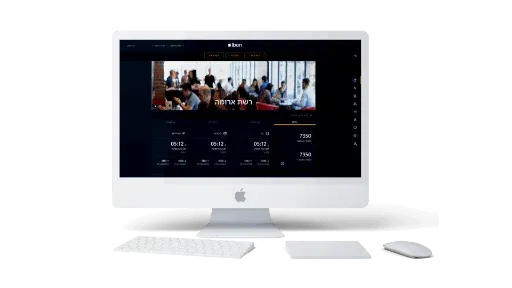
Our long-running engagements show the model at its best: continuity over years, not just a launch. We have built and continue to develop OnePager, the content tool we created for Keshet 12, and we serve as CTO for ibon, a management platform for the food industry. We have delivered projects for clients in Israel, Canada, the USA, Europe and Australia.
A typical week, sketched
Here is how a feature commonly moves through the week on a split team. Monday morning in Toronto, the client and both offices meet in the overlap to agree on scope and acceptance criteria. Israeli engineers build through their afternoon and write a handoff. The Toronto side reviews, tests and leaves questions. By the next Israeli morning, answers and review comments are waiting, and the cycle repeats. On Thursday, a recorded demo goes to the client, and Friday in Toronto is used for fixes and release preparation while Israel is off.
Questions to ask any distributed team
Whoever you hire, ask:
- What are your shared hours with my team, and what happens in them?
- Show me a real handoff note from a current project.
- Is there one backlog, and who owns each ticket?
- Who is my day-to-day contact, and in which time zone?
- How do you plan around holidays in both countries?
- Who is awake when we release, and who is on call after?
- What do you write down, and what do you rely on meetings for?
If the answers are vague, the time difference will hurt. If they are specific, it will help.
Working with us
Whether you need a custom software development team for a defined project or a long-term technology partner, you get one team across two offices, with one backlog and clear owners. If you are building something in Canada, Israel or both, tell us about it and we will show you how the day would run for your project.