Custom GPT assistants
Assistants with your tone, your rules and access to your systems. They answer customers on chat, SMS and email, or help staff draft, summarise and look things up.
// Services / AI
AI development at DevDino means custom GPT assistants, smart search over your own documents, AI agents and the data pipelines that feed them, built into products people already use. We help companies turn AI from a buzzword into features their users actually rely on.
// 01
Assistants with your tone, your rules and access to your systems. They answer customers on chat, SMS and email, or help staff draft, summarise and look things up.
Retrieval-augmented generation over your documents, wikis and tickets. Answers cite the source, respect user permissions, and admit it when the documents do not say.
Agents that carry out multi-step work across your tools: triage an inbox, update the CRM, draft the reply, open the ticket. Risky steps wait for a person to approve.
The plumbing AI depends on: pulling data from many sources, cleaning it, keeping it fresh and feeding it to models and dashboards, on a schedule or in real time.
Summaries, classification, recommendations and natural-language search added to your existing web or mobile product, behind your login and in your design.
Test sets built from your real cases, quality checks before every release, and accuracy and cost tracking in production, so the assistant stays good after launch.
// 02
A language model is a component, like a database. The work that decides whether an AI feature succeeds is everything around it: getting the right data in, keeping it fresh, controlling who sees what, catching bad answers, and keeping the system fast and affordable when real users arrive. That is software engineering, and it is what we have been doing for broadcasters, manufacturers and restaurant chains.
Instead of a slide of AI logos, here is the engineering record that AI work depends on.
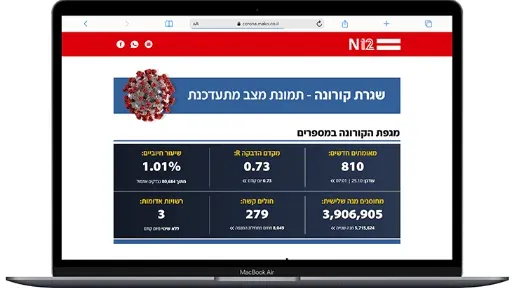
For N12 we built the Corona N12 dashboard: custom-made with .NET, pulling and presenting live data from multiple sources, including the Israeli health ministry and global health sources. Merging, cleaning and refreshing data from sources you do not control is exactly what a retrieval pipeline does before an assistant can answer anything.
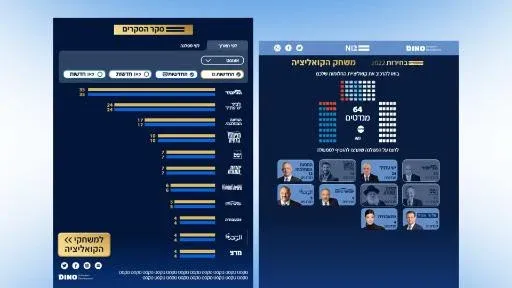
For Mako we built the elections site that shows Israel’s election results in real time. It is probably the most popular site for following the results, and we have run it for more than one election. Spikes in traffic and zero tolerance for wrong numbers are a good rehearsal for putting AI in front of the public.
For Netafim we built a web-based OEE application that gives real-time insight into production performance. Turning raw factory data into something a manager can act on is the same skill as turning raw documents into answers.
ibon is a management platform for the food industry, with real-time inventory, production lifecycle and regulatory compliance, used in over 80 Aroma branches. Business-critical systems with many users and strict rules are where AI features have to earn trust.
Not every problem needs an agent. A quick guide to what we usually recommend:
| You want to… | What we build |
|---|---|
| Answer questions from your own documents | RAG assistant with citations |
| Handle customer messages on several channels | GPT assistant connected to your CRM and inbox |
| Run a multi-step process across tools | AI agent with human approval on risky steps |
| Add AI to a product you already sell | AI features inside your codebase |
| Feed AI and dashboards with clean data | Data pipeline, scheduled or real time |
Often the honest answer is a mix: a pipeline that keeps your knowledge base fresh, a RAG assistant on top, and one or two automations that act on what it finds.
Three things decide whether an AI feature survives its first month in production.
Accuracy. We build a test set from your real cases before we tune anything, and every change is measured against it. Answers are grounded in your sources and cite them.
Privacy. Permissions follow the user, sensitive fields can be masked before they reach a model, and every call is logged. Where data residency matters, hosting and providers are chosen to match.
Cost. Model choice, caching and prompt size all change the running bill. We track cost per conversation or per task from day one, so there are no surprises when usage grows.
If you want AI across the whole organisation (use-case selection, privacy, training, change management), start with AI implementation. If the AI needs to sit inside your sales or service process, see custom CRM development, where we build assistants that answer leads by SMS, chat and email. For the wider product around the AI, see custom software development, and for a practical roadmap read how to implement AI in your organisation.
Bring us one job you would like AI to do, and we will tell you how we would build it and how we would prove it works.
// 04
Real projects for real clients. Open one for the details.

Use case
A mobile rhythm game reminiscent of Guitar-Hero, but this time - with your fingers!
special · website
The COVID-19 panel on N12 news website and app.
Project
Israel formal election website. We created a site that shows Israel Election results in real time.

Project
Introducing the new web-based OEE application for Netafim! Our innovative solution offers real-time insights into production performance, empowering Netafim to make quick and effective decisions that...

special · startups
ibon is a platform for managing and monitoring companies and organizations in the food industry.
// 05
Pick one job for AI, define what a good answer looks like, and collect real examples to test against.
A working version on your own data, judged against the test set, not on a slide.
Permissions, guardrails, logging, fallback to a person, and load testing before real users touch it.
Released into your product or systems, with monitoring for quality, speed and cost.
We review failures, grow the test set and tune prompts, retrieval and models as your data grows.
// 06
















// 07
RAG (retrieval-augmented generation) means the AI looks up the relevant passages in your own documents before it answers, and cites them. You need it whenever answers must come from your policies, products or records rather than from the model's general knowledge. For most company assistants it is the safer choice than training a custom model.
We are model-agnostic. We choose per task, weighing answer quality, speed, cost and where your data is allowed to go, and we test the options on your own examples before committing. Because the model sits behind our code, you can switch later without rebuilding the product.
We set up providers and agreements so your data is excluded from model training wherever the provider offers that, and we keep the most sensitive fields out of prompts altogether. Access controls, logs and retention rules are part of the build, not an afterthought.
We ground answers in your documents, require citations, and tell the assistant to say it does not know when the sources are silent. Before release we run it against a test set of real questions, and in production we review flagged answers. Anything high-stakes goes to a person.
Yes. We work inside your codebase and your release process, whether it runs on .NET, Angular, NodeJS or something else. AI features ship like any other feature: reviewed, tested, and behind your login.
The number of systems and data sources involved, how clean that data is, how many channels the AI must work in, and how strict the accuracy and privacy requirements are. Running costs depend on the model and the volume. We give you a written estimate after scoping, and we will tell you if a cheaper approach is good enough.
// 08
We bring AI into how your organisation works: the right use cases, your systems, your privacy rules, your people.
A CRM built around how you sell and serve, with AI that answers leads and integrations into the systems you already run.
Web apps, platforms, real-time dashboards and admin panels, built around how your business actually runs.
Tell us what you are trying to do. One of our awesome dinos will get back to you shortly.
// Projects delivered for clients in
Tell Dino about your project
Thank you! Your message is on its way, and one of our dinos will be in touch shortly.
